.jpg)
Are you familiar with the panicky feeling when you realize your dog had an accident on your bedroom carpeting? You rush to google to find out how to clean it up - you followed the regiment to perfection. You waited until it dried and congratulated yourself on your victory. Then it rains for three days, and your celebratory dance feels premature. If that's happened to you, you didn't clean badly. You simply didn’t go deep enough.
Here's the crux of the matter: with urine, the stain and the smell are two entirely separate (but connected) problems living in two different places. The stain sits on the fibers you can see. The smell lives underneath them, in a layer your cloth and scrubbing never touched. Remove the first and the second doesn't budge, it just waits. This is the science of what's actually down there, and why it wins so often.
Quick answer
Dried urine is difficult to remove because evaporation leaves behind concentrated crystalline residue that barely dissolves in water and sits far deeper than the visible spot. Household cleaning lifts the surface liquid and discoloration but never reaches the deposit, so bacteria keep producing odor — which returns whenever humidity rises.
The first month, hour by hour
Urine leaves the body around 95% water. It's the other 5% — urea, uric acid, creatinine, mineral salts, urochrome pigment — that causes every problem you'll ever have with it.
While it's wet, that 5% is dissolved and mobile. It can be diluted, absorbed, pulled back out. Then it dries, and the clock starts.
Three chemical changes drive that table.
Everything concentrates. A dilute solution becomes a dense film wrapped around individual fibers. Concentration alone makes it several times harder to shift than it was an hour in.
Bacteria manufacture the smell. Urea is odorless. It's bacteria — using an enzyme called urease — that break it down into ammonia. So old urine doesn't smell stronger because the odor built up. It smells stronger because something is down there making more of it, continuously. Meanwhile the pH climbs into alkaline territory, and that's what attacks the dyes in wool and nylon. The yellow-brown halo around an old spot isn't dirt. It's damage.
Uric acid crystallizes. As the last moisture leaves, uric acid and mineral salts precipitate into hard deposits locked into the fiber, the backing, and whatever lies beneath.
That last one is where most cleaning attempts die.
Why your household products (even DWV) never stood a chance
Household cleaning runs on one principle: dissolve it, then lift it away. Detergent handles grease. Warm water handles a spilled soft drink. Uric acid refuses to play. It's only sparingly soluble in water, meaning it needs a large volume of solvent in order to dissolve - like 7 soda bottles worth of solvent to dissolve 1 gram of uric acid so anything you pour on or spray at it, isn't carrying enough solvent to dissolve a concentrated deposit. But solubility is only half the story, and the household cleaning product industry oversells that half.
The real obstacle is reach. You're applying a few ounces of liquid to the top of a contamination cone that runs inches deep. Even a product perfectly capable of dissolving that residue never makes contact with most of it. And whatever does dissolve has nowhere to go — with no extraction,without professional urine extraction, it redeposits exactly where it was as the carpet dries.
It isn't a cleaning failure. It's a mathematical one. The carpet looks clean afterward because the part that was visible was the only part you could reach.
The humidity switch
Here's the mechanism behind the three-days-of-rain problem.
Dried urine salts are hygroscopic; they pull moisture out of the air around them. In a dry room, the deposit sits inert, and everything seems fine. Raise the humidity, through wet weather, a running humidifier, or the water from cleaning the carpet, and the deposit rehydrates. Dormant bacteria wake up. Ammonia production restarts. Which explains something that sounds like a cruel joke but happens constantly: carpets that smell worse right after being cleaned. Nobody made a mistake. Water was reintroduced to a deposit that had been waiting years for it. It's also why an accident from last autumn can announce itself in July with no warning. Nothing new happened. The weather changed.
Try this tonight
Wait until dark, kill every light in the room, and sweep a UV blacklight across the floor.
Compounds in dried urine fluoresce. The glowing patches are the real footprint — and almost everyone is startled by how much larger they are than the spot they'd been treating. Some people find contamination in rooms they'd have sworn were clean.
It's the single fastest way to understand why surface cleaning keeps failing. You've been treating the tip of something.
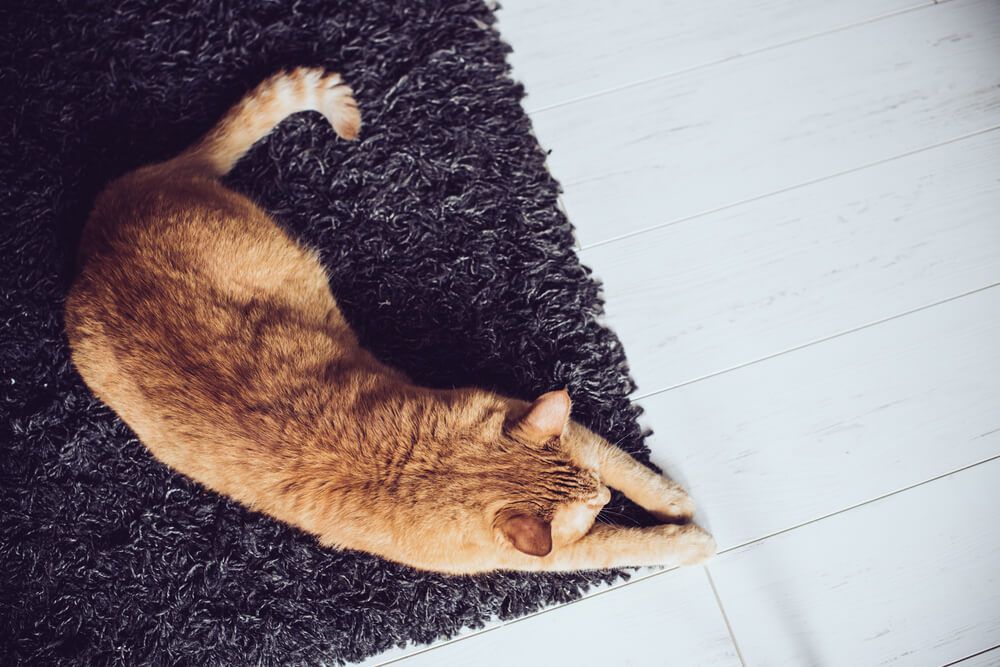
Why cat urine plays by different rules
Cat urine isn't a stronger version of dog urine. It's a different chemical problem.
Cats excrete a sulfur-containing amino acid called felinine. As felinine degrades, it produces a thiol — the same chemical family responsible for skunk spray. Human noses detect thiols at almost absurdly low concentrations, which is why a small, weeks-old cat spot can take over an entire floor of a house while a comparable dog accident goes unnoticed.
Two consequences worth knowing. Felinine breaks down gradually, over weeks. So a cat spot can genuinely get worse the longer it sits — the exact opposite of how nearly every other stain behaves. And felinine production is testosterone-dependent. Intact males produce dramatically more than females; kittens under about three months produce essentially none. If one cat in a household leaves spots that are far harder to deal with than another's, that's usually your answer.
There's a behavioral angle too. A cat's nose vastly outperforms yours, so a spot you've declared clean may still be perfectly detectable to the animal. Cats returning to the same square foot is a pattern every owner recognises, and residual odor is the usual explanation — though the precise role these compounds play in territorial marking is still debated rather than settled.
The spot you see versus the spot that exists
Liquid hitting carpet doesn't stay put. It spreads downward and outward as it sinks, in a cone — and the visible mark is the narrow point at the top. Underneath, the stain in the padding is typically much wider. With a larger accident it can reach the subfloor and even wick into concrete pores or the seams between floorboards.
Surface cleaning addresses maybe the top third of what's there.
Mattresses are the worst case. Foam is engineered to absorb and hold, there's no barrier layer, and there's no practical way to extract from the core without professional mattress cleaning equipment.. Urine that reaches the interior releases odor through the cover indefinitely.
Upholstery and furniture hides it in cushion foam and the webbing beneath the frame. Fabric that looks and smells perfectly clean can be sitting directly on a saturated cushion interior.
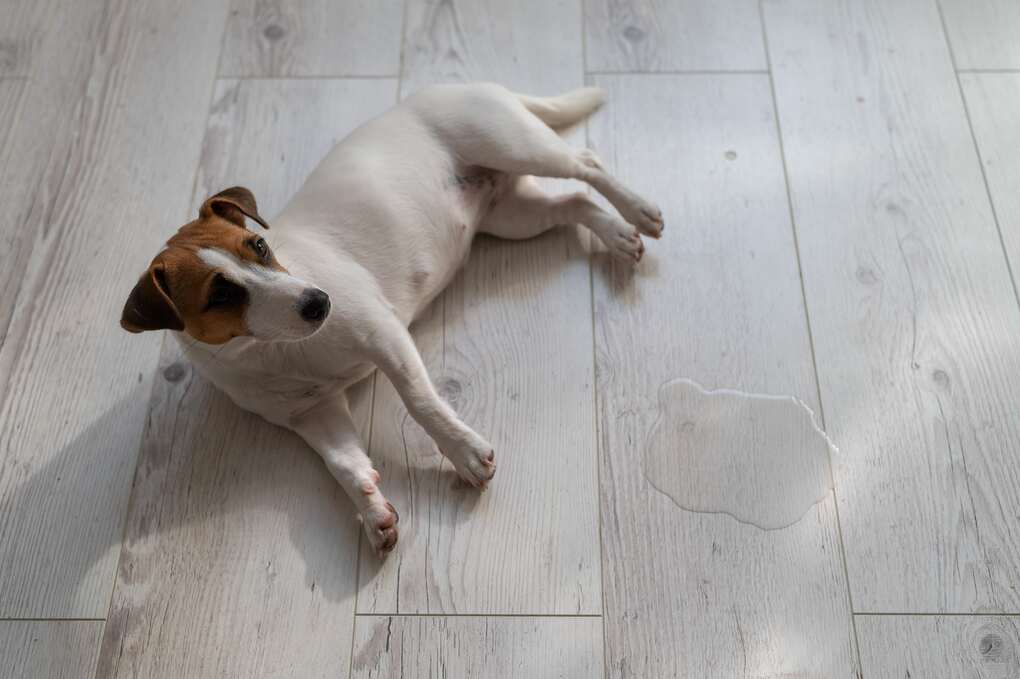
Hard floors don't get a pass
It's tempting to assume tile and hardwood escape all this. They mostly don't.
Grout is porous by design. The tile wipes clean in seconds; the grid between the tiles holds the deposit.
Hardwood lets liquid run down the seams between boards to the unfinished underside and the subfloor. The finish on top can look flawless while contamination sits directly beneath it. (this applies to your vinyl plank as well - not much stops liquid despite what they claim.)
Concrete is the most absorbent surface in the house — riddled with capillary pores. Urine that reaches a slab often requires sealing rather than cleaning, because extraction isn't realistically possible.
The pattern holds everywhere: the surface you can see and the material actually holding the odor are frequently not the same material.
Why every week makes it harder
Time doesn't just make a urine stain older. It changes what the stain is.
At two hours, it's a liquid to be absorbed. At two days, it's a bacterial colony producing ammonia. At two months, it's a bonded crystalline deposit distributed across three layers of material, most of which you can't see or reach.
Each stage needs a fundamentally different approach than the one before it. That's not a stain getting harder. That's four separate jobs wearing the same yellow mark.
The bottom line
Dried urine wins because drying transforms it. What went down as a liquid becomes a crystalline deposit and a working bacterial colony, sitting below the surface, out of range of anything you apply on top.
So the question was never really how to get the stain out. (Although we just learned that sometimes those are permanent, right?)
The stain was never the problem. The thing underneath it was — and until that's broken down and physically removed, the smell always has somewhere to come back from.
Understanding the cause is step one. For the practical side, see our guide to removing dried urine odor from carpet, upholstery and mattresses.